ALPACAM
Jump-starting momentum with gamified habit-building for procrastination

Mobile, Social
4 months
Product Designer
01
What Is It?
ALPACAM is a gamified habit-building app designed to help young adults overcome procrastination and build momentum in starting tasks. While many productivity tools focus on planning, organization, and concentration, they often overlook a deeper challenge: the gap between knowing what to do and actually starting.
Instead of emphasizing long to-do lists, ALPACAM reframes task initiation through randomized, time-limited daily missions. These light, achievable prompts lower the barrier to action and create early wins that compound into progress.
Grounded in user psychology and behavioral science—and supported by gentle gamification and social touchpoints—ALPACAM transforms starting into a habit, helping users jump into their day with less hesitation and more momentum.
02
Have a Look
03
My Impacts
Later usability testing showed that ALPACAM was not only engaging and intuitive, but also effective as an intervention. Follow-up testing and interviews revealed that within the first week, participants reported a noticeable drop in procrastination-related hesitation and stronger positive associations with starting tasks. These early gains have continued to trend upward with extended use, suggesting strong potential for deeper impact over time.
The project’s approach has attracted interest from not only users, but also researchers exploring novel interventions for habit-building, procrastination and motivation, making ALPACAM as both a promising tool for young adults and a potential model for further study in behavioral design.
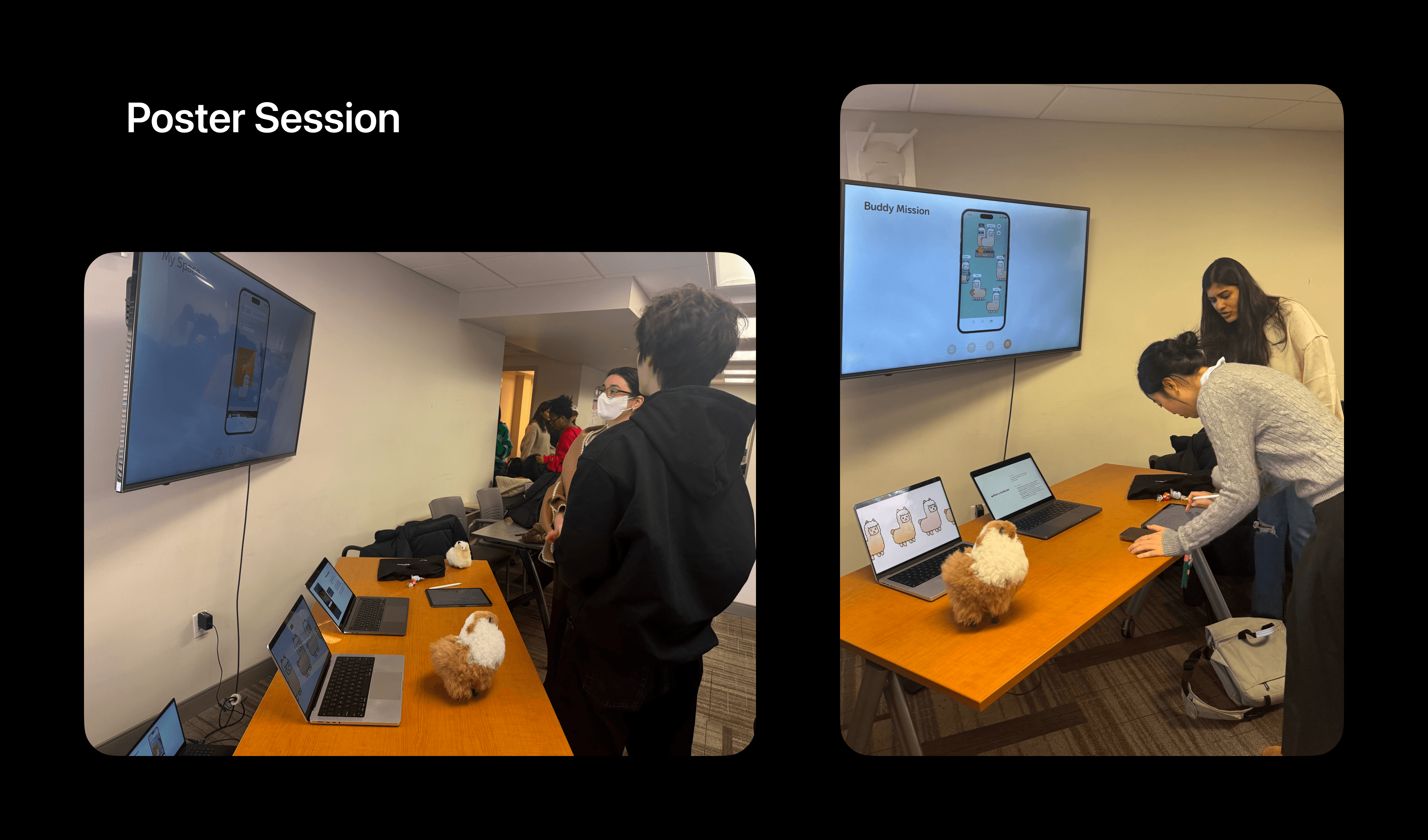
04
Behind the Scenes
What Is the Problem?
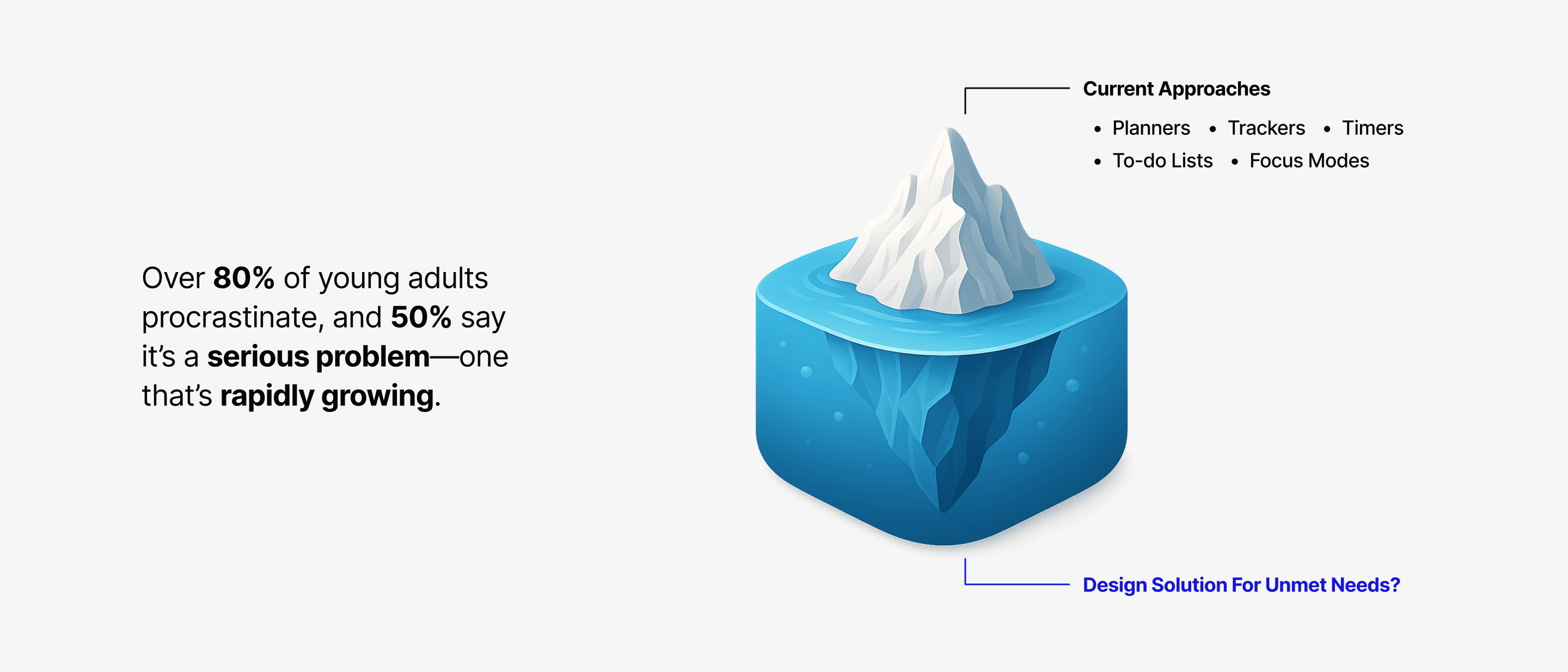
Our team noticed that despite a saturated productivity app market filled with trackers, timers, and to-do lists, procrastination persists to be a common problem among teens and young adults.
Thus, We set out to uncover and design for the deeper unmet needs that cause people to struggle with starting tasks, even when they know what to do.
Preliminary Research Insights
We started with open-ended design research, combining metaphor analysis, literature review, expert interviews, and competitive analysis to uncover hidden causes of procrastination.
Our research revealed a key insight: most tools focus on planning for tasks or sustaining focus during tasks, but they overlook the critical moment in-between — the psychological barrier of getting started, often associated with fear, overwhelm, and negative emotions.
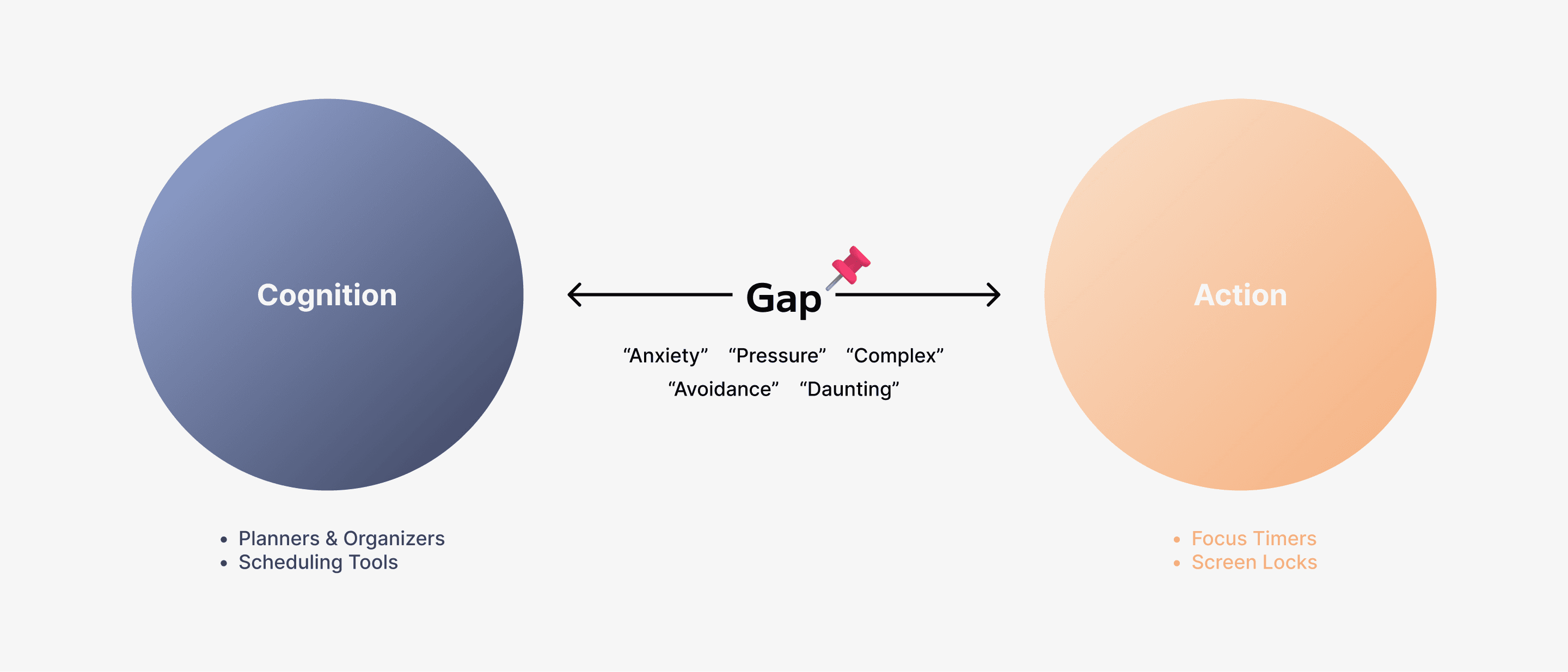
From these insights, we reframed the challenge into a guiding question:
How might we transform negative task perceptions into a positive habit of jump-starting through playful, low-friction interactions and social reinforcement?
Ideation and Theory Testing
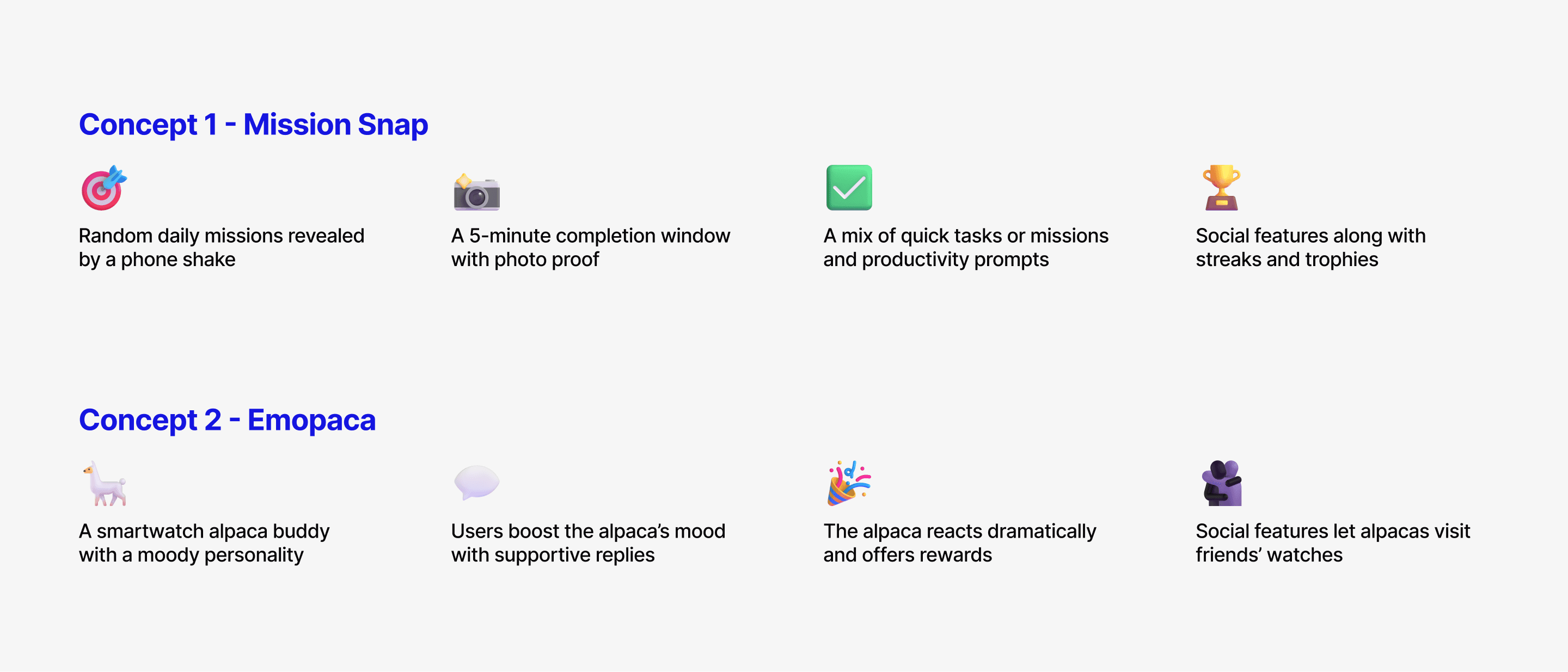
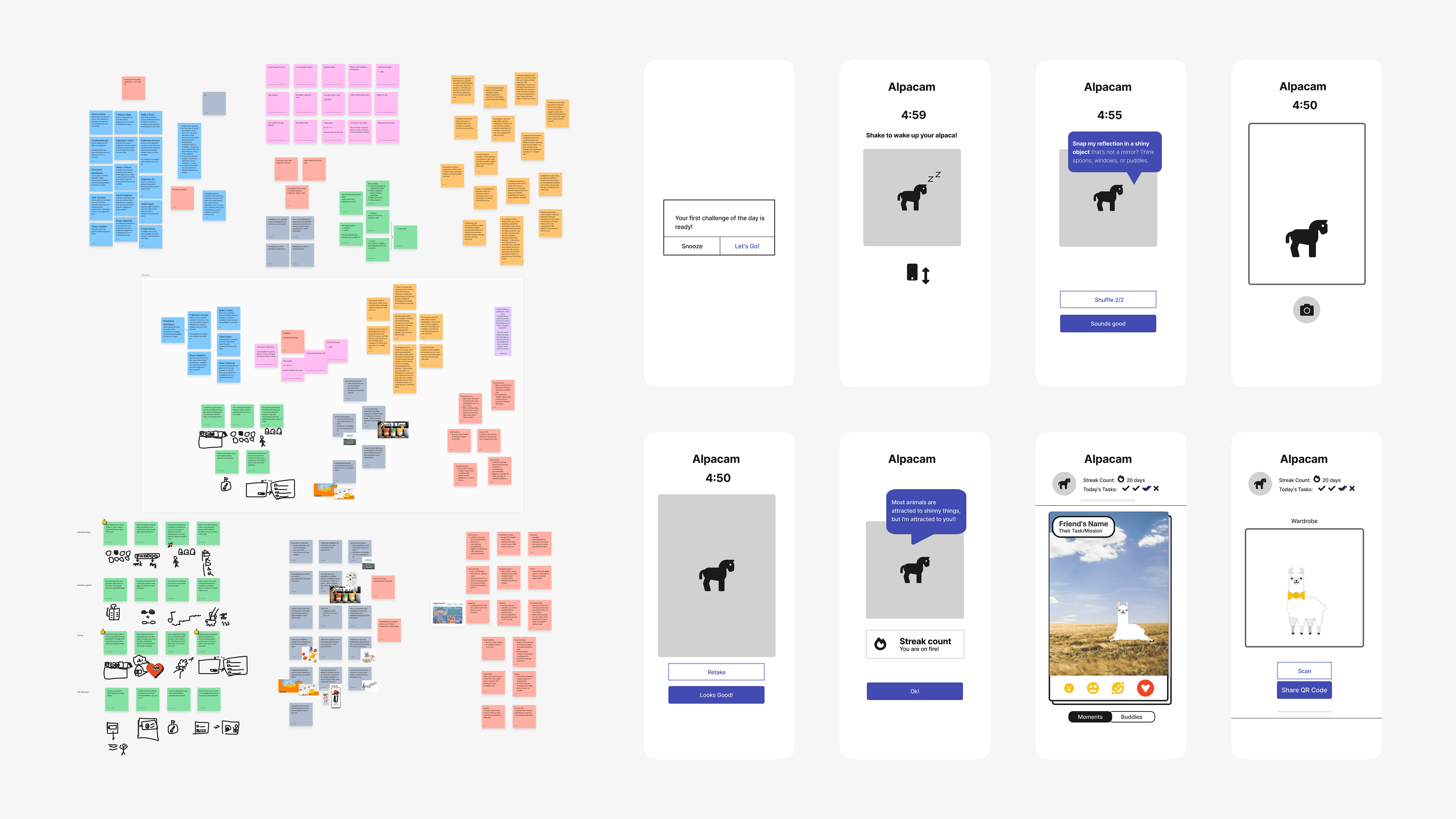
As a team, we conducted rapid ideation, focusing on embedded design concepts that subtly promote habits by avoiding explicit, directive, or obvious interventions. We converged on two concepts through affinity diagramming:
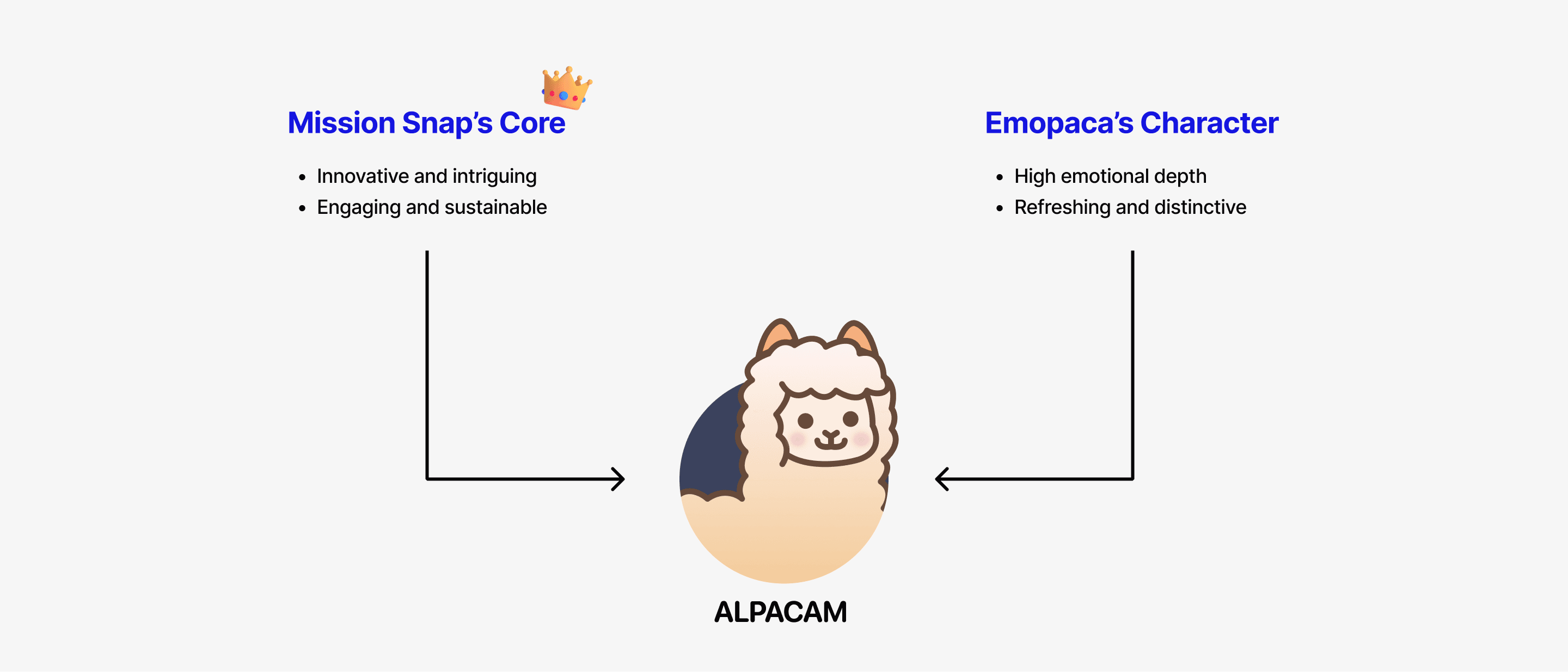
Mission Snap: A minimalistic interaction that asks users to “jump-start” by snapping a photo of a random task.
Emopaca: An 'emo' companion that promotes the user to cheer it up—leveraging cognitive dissonance to nudge users into action.
We evaluated both concepts through focus groups and pre/post testing. Participants gravitated toward Mission Snap, describing it as engaging, novel, and sustainable. At the same time, they valued the emotional depth of the 'emo' companion, which felt refreshingly distinctive. Thus, we combined Mission Snap’s flow with Emopaca’s companion dynamic, forming the basis of ALPACAM’s final experience.
Decisions That Shaped Our Design
ALPACAM’s design was shaped by both good UI/UX practices and scaffolded psychological interventions addressing the behavioral needs behind procrastination. Together, the mission system, companion experience and social gamification elements created an app that felt playful, supportive, while forming positive habits.
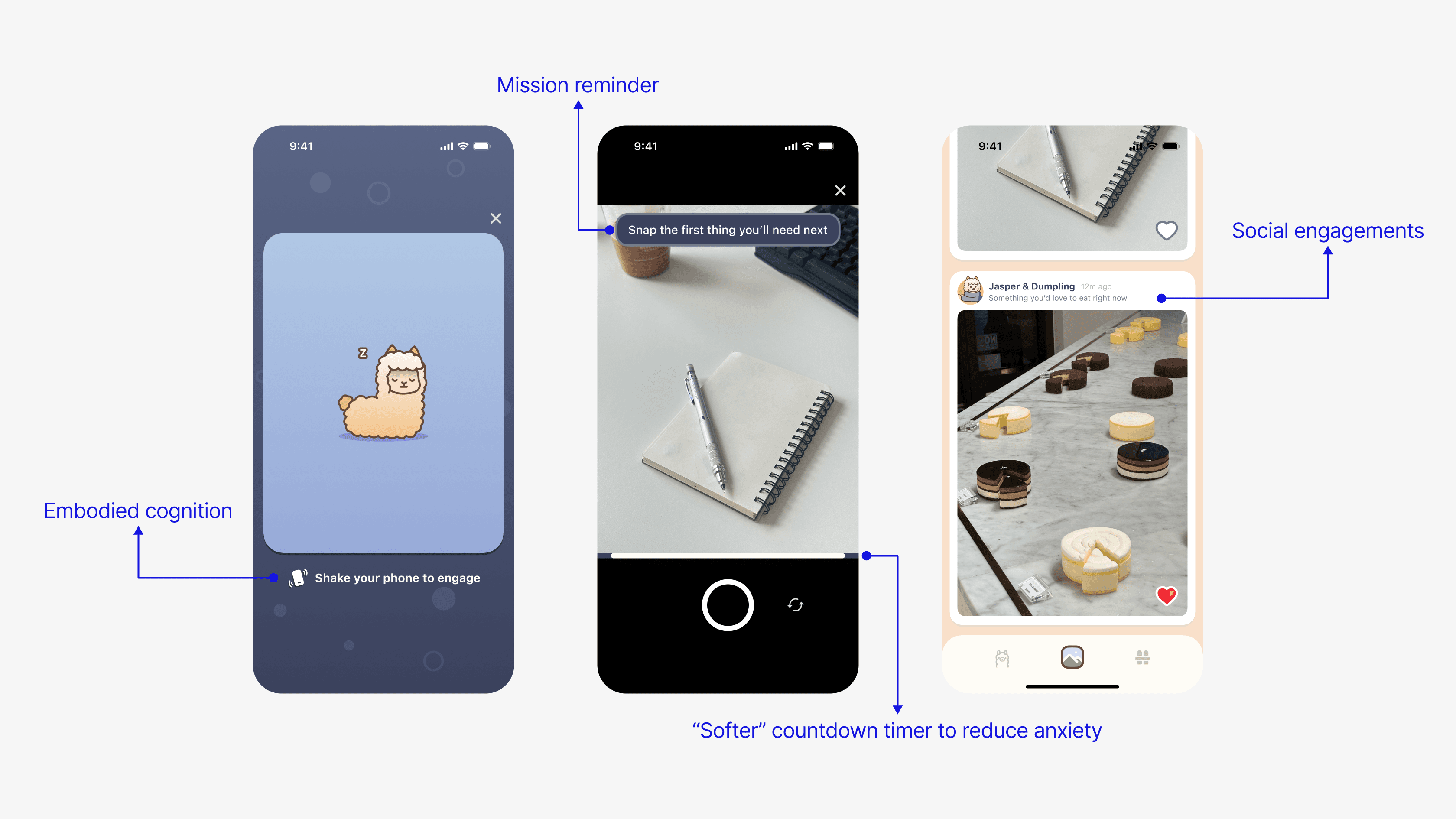
5-Minute Jump Start Missions: To lower activation effort, we designed lightweight five-minute missions — 3–4 randomized prompts per day. Some missions nudged productivity while others remained playful, keeping the experience fresh and approachable.
To further boost engagement, missions were triggered by simple embodied gestures — small physical actions that prepared users mentally before starting.
Visual Style & Personal Companion: The visual style was crafted using mood boards to reflect and shift users’ cognitive mindsets. Cool tones signaled the weight of procrastination, while warm, inviting tones marked positivity and progress. As missions were completed, this shift primed users to associate task initiation with a sense of reward.
At the center was Emopaca, a customizable companion that users “cheered up” by completing missions—turning self-improvement into a supportive, relationship-driven experience.
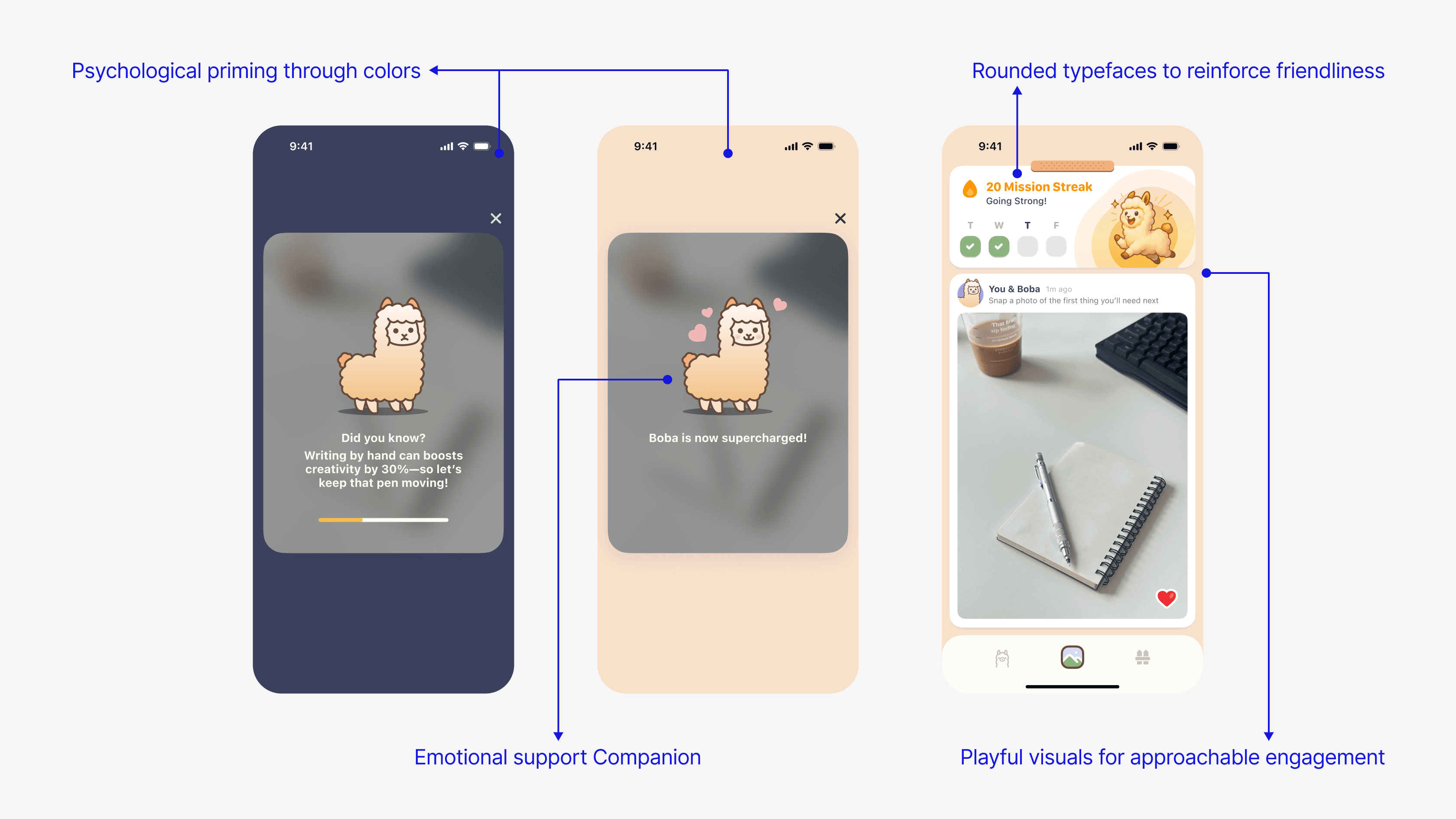
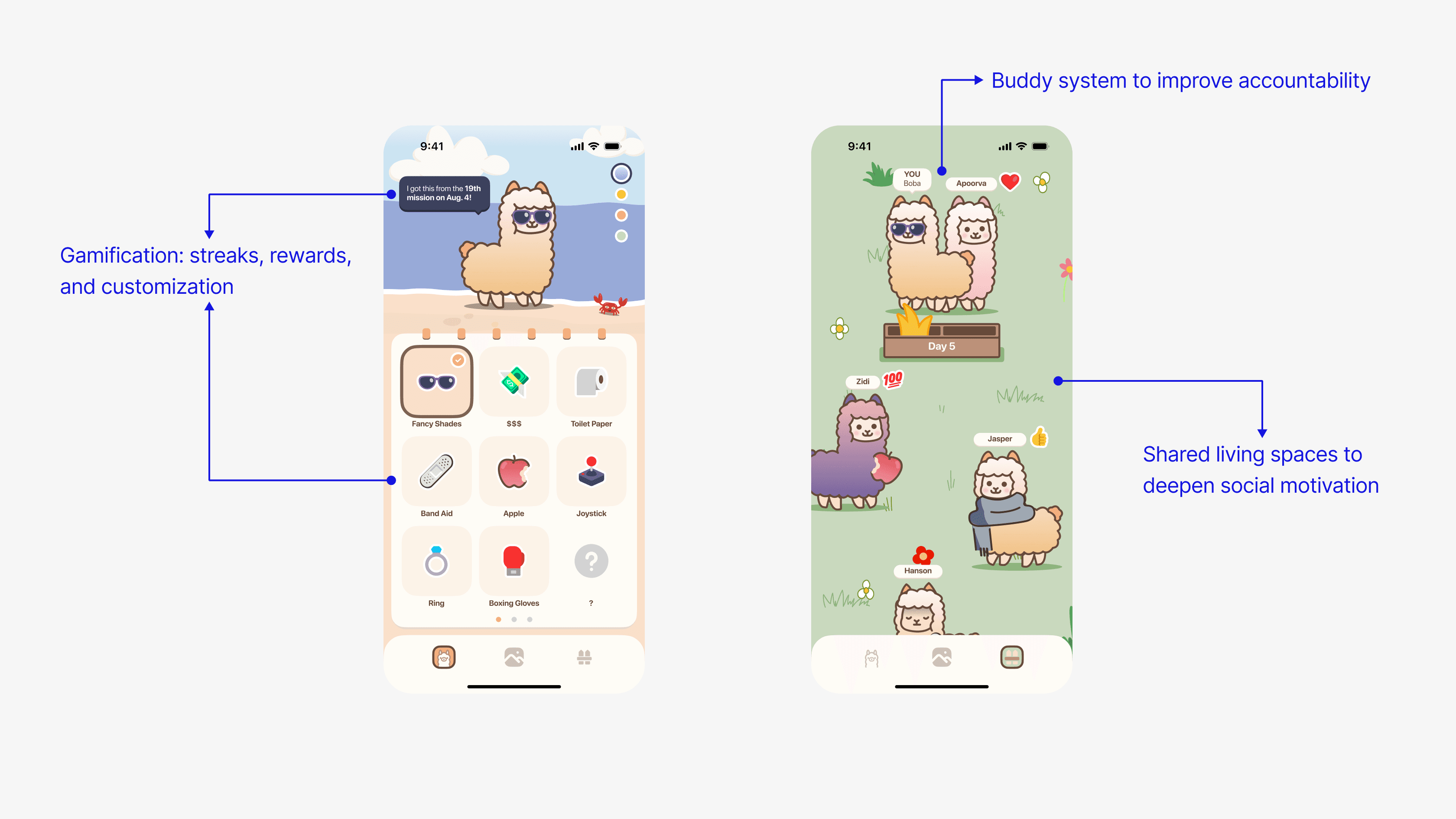
Social gamification: To sustain engagement, we balanced social and individual motivators. Features such as Buddy Missions, friend “ranches,” and light-hearted interactions leveraged social proof to make progress contagious.
At the individual level, gamified elements including streaks and companion customization reinforced consistency without pressure. Together, these systems balanced community motivation with self-driven personal achievement.
Iterate, Iterate, Iterate
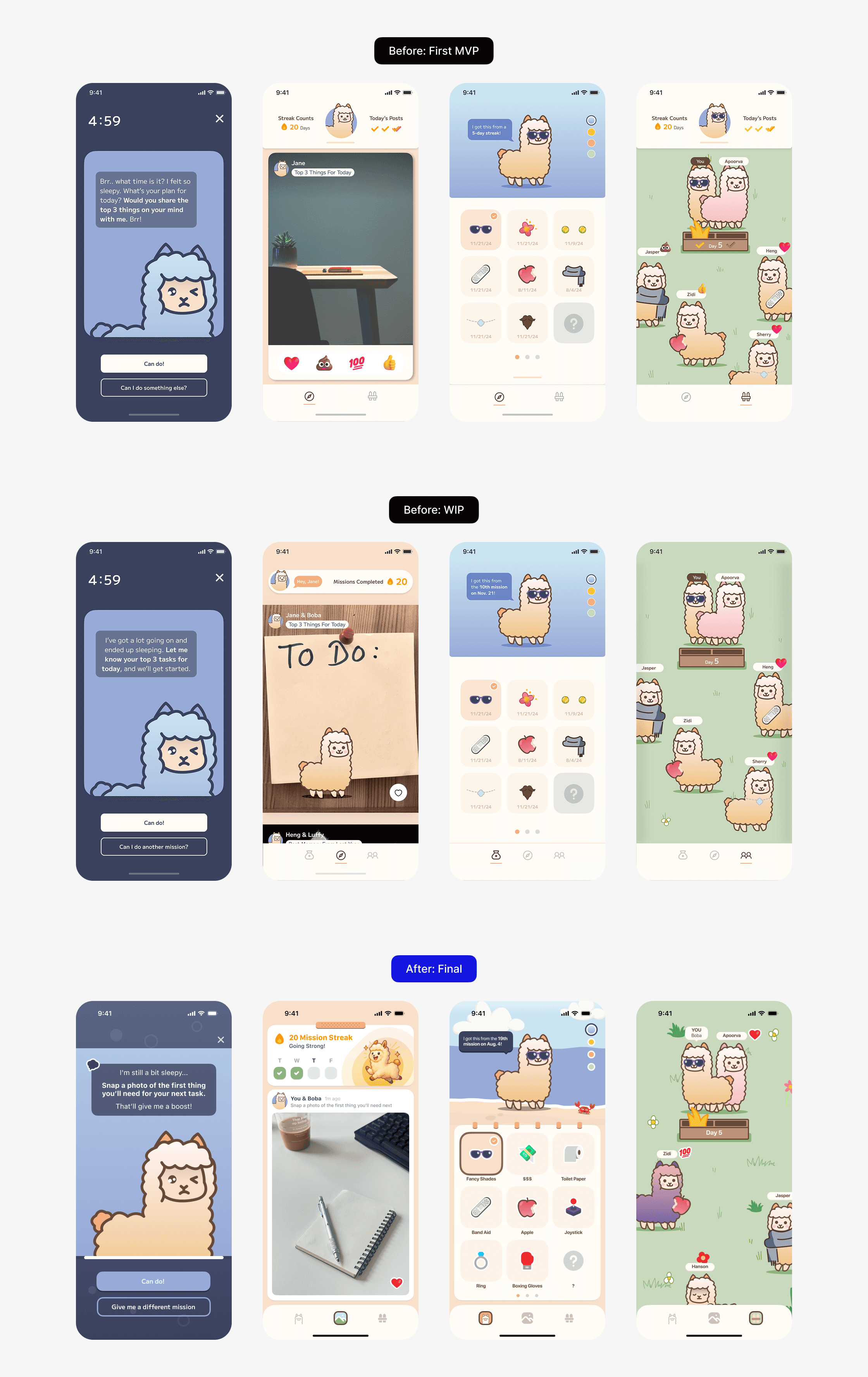
We conducted three iterative rounds of usability testing, using think-aloud protocols, guided tasks, and pre/post surveys to ensure the experience was seamless, motivating, and intuitive. This process surfaced friction points and helped us to refine both the psychological scaffolds and the UI/UX details.
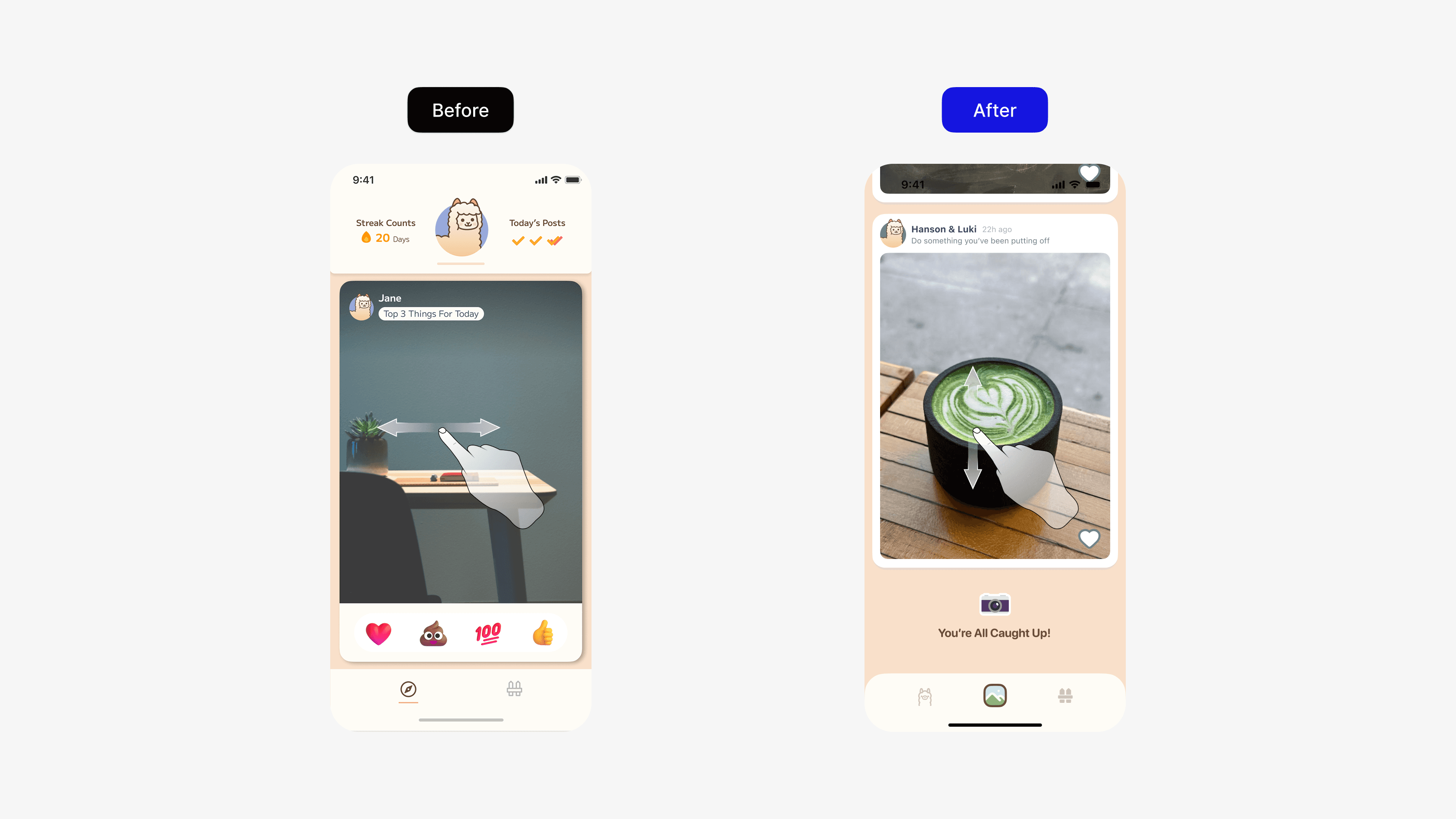
Swipe vs. Scroll: We originally used swipeable cards to discourage doom scrolling, but testing revealed the pattern felt unintuitive and unfamiliar. We reverted to a scrolling feed with a "soft limiter" (recent posts only) to align with user expectations.
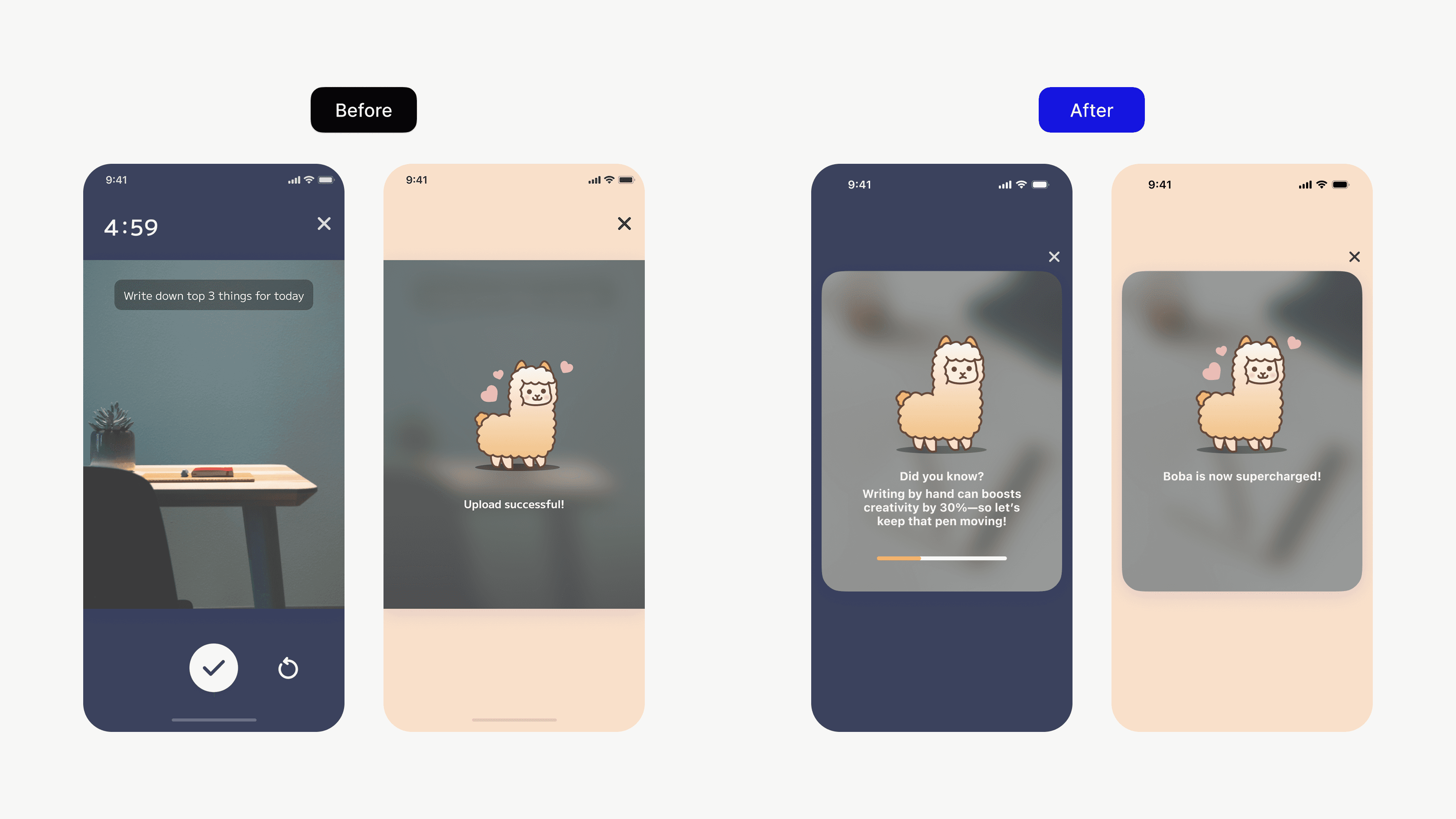
Affirmation Messages: The upload pause after missions disrupted momentum, so I introduced affirmation messages during this stage. This kept energy flowing and aligned interaction design with our goal of sustaining continuous motivation.
Additional Refinements: To lower pressure and encourage engagement, I reworked streaks to track missions completed instead of days. I also tightened UX writing for clarity and added contextual onboarding to speed up first-time user orientation and reduce cognitive load.
05
Always Room for Reflections
Designing ALPACAM challenged me to think deeply about why people procrastinate and how design can address the psychological barriers behind it. Unlike typical productivity tools, our approach required balancing playful, social experiences with persuasive behavioral interventions—motivating without overwhelming.
Throughout the process, I learned how to integrate research-driven insights with creative design strategies, using small interactions to spark meaningful change. The project reinforced my belief that effective design doesn’t just streamline tasks—it reshapes perceptions, turning intimidating challenges into approachable steps.
In the end, ALPACAM became more than a productivity app concept—it became an exploration of how psychology and design can work together to help people build confidence, start sooner, and sustain momentum toward their goals.